When the World Cup rolls around, it feels like we have this conversation on rinse and repeat. People start guessing winners early. They debate squads and managers. They discuss stadiums, matches, and tickets, and who is running to achieve the most destinations.
The FIFA World Cup 2026 will receive similar attention. It will be larger than in past editions. More teams. More matches. More noise. And when it takes place around the United States, Canada, and Mexico, football’s business side will expand even further.
But there is something funny about how we talk about Football.
We talk about everything except the ball.
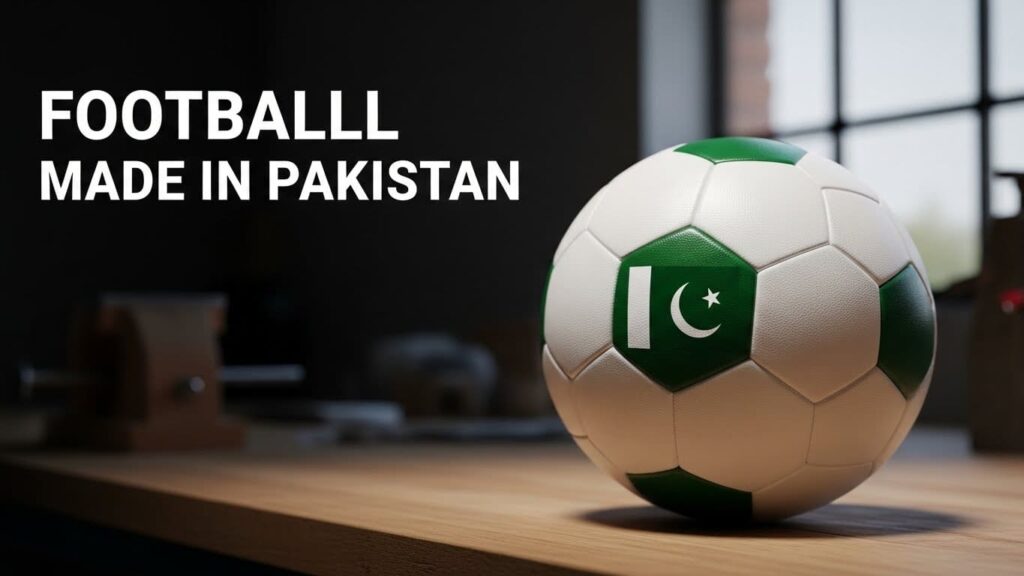
Not in a poetic way. Literally the ball itself, I mean. The thing every player touches. It’s that which determines whether a shot bends properly or passes it to heaven prematurely. That ball is no magic totem. It is made by people. And many of the footballs used around the world are produced in Pakistan.
That fact is not new. It has been true for years. But most fans outside Pakistan have no clue. It is not often discussed, not even by a surprising number of Pakistanis.
If you want to get a sense of football made in Pakistan, the place to start is Sialkot.
Sialkot is at the core of Pakistani football culture. To fully appreciate it, one needs to begin here and understand all aspects of this beautiful game.
Sialkot is Famous for Football Manufacturing
Sialkot does not appear in sports headlines. It is not a metropolis renowned for its large stadiums or football clubs. But in manufacturing, it has earned a place in global football history. People who work in sports goods know the name. Buyers know it. Brands know it.
Sialkot became important because the work stayed consistent. That is the real reason. Export markets are not emotional. Buyers do not care about national pride. They care about deadlines, quality, and performing well enough to be hired again. Sialkot continued to deliver, and that is why the industry survived.
It is not one factory there, the football industry. It is a chain. Cutting panels. Shaping layers. Stitching. Printing. Quality testing. Packing. Shipping. Thousands of workers support it. They grew up around the same work, many of them. They are not reading theory about football production. They know which errors cost money.
Sounds straightforward enough. Yet confidence is at the heart of this industry. A ball that looks fine at first can still fail after just one use. That’s why reputation matters in this business.
Why football made in Pakistan still sells around the world
Let’s keep it honest. Footballs sell for one reason. They work. If they do not, buyers move on quickly.
Football made in Pakistan, especially training footballs, is popular because it lasts. People in academies and clubs need footballs that survive daily use. The stitching matters. The shape matters. The grip matters. Losing air and losing shape are sure signs that a ball has gone sour and should never be trusted with brand labels on it.
Pakistan is well known for hand stitched footballs. That is still a big advantage in some markets. Hand stitching is not only a tradition. It often produces strong seams and better durability. When done properly, the ball holds shape longer and handles rough use better.
Another reason is that Pakistani manufacturers understand export requirements. They are used to strict standards. Weight must be within range. Shape must be consistent. Air retention must be tested. Batches must match the sample. If they fail, buyers do not return. Existing factories have learned how to meet those expectations.
Pakistan remains competitive due to a combination of factors, including cost. Pakistan remains competitive thanks to offering an attractive balance. Not cheap junk. Not overpriced. The kind of quality that works for large orders.
Taking stock of the FIFA World Cup 2026 can be a game-changer for Pakistan’s football Industry
Demand always jumps at World Cup time. Brands release special editions. Retailers order more stock. Clubs and academies grow training supplies. Football becomes more visible everywhere. Even people who have never watched football now want to have a ball in their home.
In 2026, that demand will be greater because the tournament itself is larger. With more teams and a longer tournament, the World Cup market will grow fast.
Official match balls are one small part of the market. The bigger market is training balls and merchandise footballs. The footballs were sold to fans. The footballs bought by kids. The footballs were ordered by training centers.
Pakistan can supply that. Sialkot already has the capacity. The problem is not whether Pakistan can make footballs. The problem is whether Pakistan will get proper value and recognition from this cycle.
For years, Pakistan has done the work while someone else gets the spotlight.
The hard parts Pakistan must face if it wants real Growth
Pakistan’s football industry has strengths, but it also has weaknesses that are easy to ignore until they become serious.
The first issue is technology. Many high-end footballs now use thermal bonding. Machine-based production has expanded in other countries. Pakistan’s hand stitching is valuable, but Pakistan needs modern capabilities too if it wants to compete in premium markets. That requires investment, training, and better testing systems. Otherwise, Pakistan gets stuck in the same segment while others move ahead.
The second issue is worker welfare. International buyers care about labor standards more than before. Pakistan must keep improving working conditions, pay structures, and safety. Not for international approval, but because workers deserve it. Also because unstable labor conditions always damage business eventually.
The third issue is branding. This is the biggest one.
Pakistan produces footballs for global brands, yet national brands remain obscure. That means Pakistan earns manufacturing income, but it does not build market identity. Real money is in branding, not only in production. Pakistan needs to build brands that can sell globally under a Pakistani name.
What Pakistan should do before 2026
Pakistan should take local football brands seriously and push them into international markets. Not as a flank undertaking, as a project. Better packaging, better marketing, stronger distribution. It can be done. The effect quality is already there.
Pakistan should even fund the recent production modes while keeping its craftsmanship. Thermal bonding, machine stitching, better materials, better quality labs. These upgrades decide whether Pakistan stays relevant in the next decade.
Pakistan should also stop hiding its story. Sialkot is a seat for multinational football manufacturing. That is not something small. That is to display proudly.
Conclusion
Pakistani footballers have been representing the country in international football for many years. That is not one of our commonly disputed problems, however. That’s a case of branding and visibility, not industry-specific.
There is nothing wrong with the possibility, and that’s what a 2026 World Cup would be. The demand will pick up, and the world’s attention will follow. Pakistan can also accomplish that, but it must involve more than just material support. Pakistan must proceed with the duration, improve working conditions, and develop brands that revive Pakistan’s sense of pride and fulfillment by 2026. Pakistan must not remain quiet in that historic competition. The world should be mindful of its grant.