
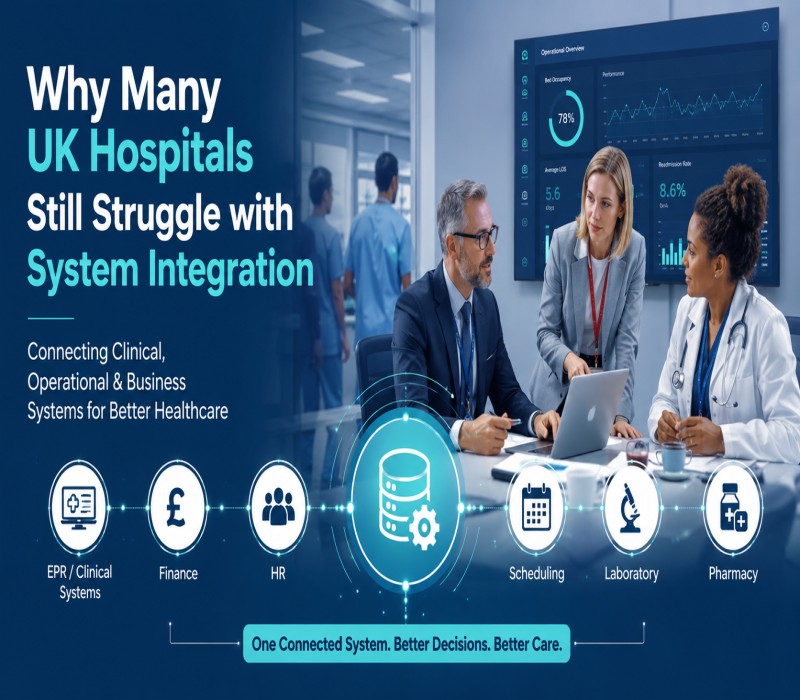
Walk into almost any hospital and you’ll find dedicated teams working hard to deliver the best possible care. Clinicians, administrators, finance teams, procurement specialists and operational managers all play an important role. Yet behind the scenes, many of them are still working with systems that don’t communicate effectively with one another.
Most hospitals in the UK have invested in digital systems over the years. The challenge isn’t having the technology—it’s making different systems work together so staff can spend less time chasing information and more time supporting patients.
The result isn’t simply an IT issue. It affects the way organisations work every day.
The Problem Isn’t a Lack of Technology
Many healthcare organisations already have good systems in place.
Electronic Patient Records, finance software, HR platforms, procurement systems and scheduling tools all serve important purposes. The difficulty begins when information has to move between them.
A patient’s appointment may be updated in one system, while another department is still working from older information. Finance teams may require reports from several applications before they can produce a complete picture. Operational managers often spend valuable time bringing together data that already exists—but in different places. Connecting these systems more effectively has become a priority for many hospitals, which is why Microsoft Dynamics 365 Healthcare solutions are often considered as part of wider integration projects.
Small Gaps Quickly Become Bigger Problems
Most integration challenges don’t begin with major failures.
They start with everyday tasks.
Information entered more than once.
Departments sending spreadsheets by email.
Teams making phone calls simply to confirm information already exists somewhere else.
Individually, these tasks may seem minor. Across an entire hospital, however, they add up to hundreds of hours that could be spent supporting patients instead of managing administration.
Perhaps more importantly, disconnected systems make it harder for leaders to see what’s really happening across the organisation. Decisions become slower because information has to be collected from multiple sources before anyone feels confident acting on it.
Integration Is About People as Much as Technology
When people hear the phrase “system integration”, they often imagine a complex IT project.
In reality, the goal is much simpler.
It’s about helping people do their jobs without unnecessary barriers.
Imagine a patient being referred between departments. If every authorised team can access the right information at the right time, there is less duplication, fewer delays and a smoother experience for both staff and patients.
The same principle applies to finance, workforce management, procurement and reporting. Connected systems reduce repetitive work, allowing departments to focus on delivering services rather than moving information from one application to another.
Building Connections Instead of Replacing Everything
One of the biggest misconceptions is that organisations must replace every existing system before integration becomes possible.
That is rarely the case.
Many UK hospitals are choosing to connect the technology they already use rather than starting again from scratch. By allowing information to move securely between systems, organisations can improve collaboration while protecting previous technology investments.
Solutions such as Microsoft Dynamics 365 Healthcare solutions are increasingly being used alongside existing healthcare platforms to connect operational processes, improve visibility and support better communication across departments.
The objective isn’t to add more technology. It’s to make existing technology work together more effectively.
A Better Foundation for Future Healthcare
The conversation around digital transformation often focuses on new technologies such as artificial intelligence or advanced analytics.
However, these initiatives depend on one essential requirement: reliable, connected information.
Without integrated systems, organisations continue to spend valuable time reconciling data instead of using it to improve services.
For NHS Trusts, private hospitals and healthcare organisations across the UK, system integration is becoming less about technology projects and more about creating an environment where staff can work together more efficiently.
When information flows naturally between departments, organisations are better equipped to improve operational performance, respond to changing demands and ultimately provide a better experience for both patients and healthcare professionals.
If your organisation is reviewing its digital strategy or looking to improve the way systems work together, it may be worth taking the opportunity to speak with our healthcare technology specialists to explore practical approaches that fit your existing healthcare environment.
