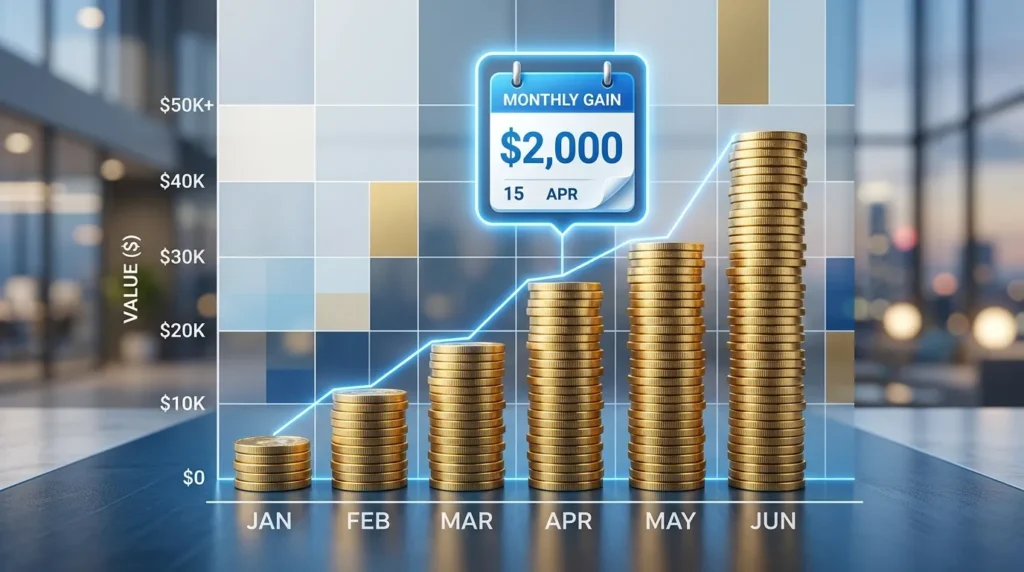
Imagine opening your account on the first of each month and finding $2,000 sitting there from dividend investing; its promise has lured so many towards its pursuit as an avenue toward financial independence.
But just how much money it actually takes to reach that target is dependent upon your yield, risk tolerance and patience levels. In this guide we’ll go through the math of earning $2,000 monthly dividend income; explore various yield scenarios; and define exactly what “break-even” means when building income portfolios.
How Dividend Income Works (Quick Refresher)
Before diving into the numbers, it helps to get on the same page about how dividends actually work.
Dividend Yield Explained
Dividend yield is simply the percentage of a stock’s price that gets paid back to you each year in dividends. Higher yields typically involve greater returns per dollar invested; however, higher risk can often accompany greater rewards; we will discuss further later.
Monthly vs. Quarterly Payout Schedules
Quarterly dividend payments mean that, if you want to achieve an even $2,000 in monthly income, you will need to assemble a dividend portfolio with multiple payout dates where those payouts can be distributed on a monthly basis. This can also be accomplished with the help of dividend ETFs and the few stocks offering dividends on a monthly basis. The math to achieve dividend income is still the same in each case.
The Core Formula Calculating Required Investment
Annual Income Needed
The first step is turning your monthly goal into an annual one. $2,000 a month means you need:
$2,000 × 12 = $24,000 per year in dividend income.
The Formula
You just need to know your annual target to understand the equation.
Required Investment = Annual Income Needed ÷ Dividend Yield
Simple Example
Let’s say you’re looking at a portfolio yielding 5%. To find out how much you’d need invested:
$24,000 ÷ 0.05 = $480,000
That’s the core calculation the rest of this article builds on. Now let’s see how that number shifts depending on the yield you’re targeting.
How Much to Invest at Different Yield Rates
Yield has the single biggest impact on how much capital you need. Here’s how the numbers shake out for a $24,000 annual dividend target:
| Dividend Yield | Investment Needed |
|---|---|
| 3% | $800,000 |
| 5% | $480,000 |
| 7% | $342,857 |
| 10% | $240,000 |
At 3% Yield
A 3% yield is common among blue-chip, dividend-growth stocks think large, stable companies with decades of dividend increases behind them. Safer, but you’ll need a much bigger nest egg: $800,000.
At 5% Yield
A 5% yield provides more realistic expectations for many income investors, representing $480,000 over 15 years. You’ll typically find such options among solid dividend payers such as utility stocks or ETFs offering dividend income.
At 7% Yield
At a 7% yield, your minimum investment drops to roughly $342,857. This yield range is typically associated with sectors with higher-payout levels such as energy or telecoms as well as closed-end funds with solid options but potentially greater price volatility.
At 10%+ Yield (and the Risks That Come With It)
Achieve 10 percent yield without taking risks is tempting, yet that requires $240,000 on paper alone – yet yields that high often indicate risk: decreasing stock prices, unsustainable payouts or an organization facing financial pressures. Chasing high yield without conducting due diligence on fundamentals may end up costing principal instead of yielding income.
Break-Even Explained What It Really Means
Break-Even in the Context of Dividend Investing
“Break-even” here doesn’t mean recovering a loss it means the point at which your invested capital is fully generating the income you originally set out to earn. In other words, the moment your portfolio’s dividend output actually equals your $2,000/month target.
Time to Break-Even Based on Contribution Rate
Your break-even point depends on your regular contributions if you don’t invest the target amount of $480,000 or more at once. A regular $2,000 investor takes much longer to reach the target compared to the $5,000 investor before considering any portfolio growth or reinvested dividends. Each of these factors shorten the timeframe even more.
Reinvestment vs. Taking Income Immediately
There is also a choice to make concerning dividends. Either reinvest your dividends (a DRIP or Dividend Reinvestment Plan) or immediately withdraw the income. The balance and break-even point become favorable quicker since reinvesting dividends compounds progress. However, if income is withdrawn, growth becomes slower but income becomes immediate.
Factors That Change the Numbers
Taxes on Dividend Income
Dividends aren’t automatically tax-free. The taxation of qualified dividends is typically with capital gains tax rates and the non-qualified (ordinary) dividends can be taxed under regular income. In either case, the tax-free amount of $2,000 per month tends to be more expensive than the prior-tax figures previously mentioned.
Dividend Cuts and Yield Traps
A company can cut or suspend its dividend at any time, especially during economic downturns. High-yield stocks that look attractive on a spreadsheet can quietly become “yield traps” companies whose share price has fallen so much that the yield looks inflated, right before a dividend cut.
Inflation’s Effect on Real Returns
$2,000 today won’t buy the same amount in ten years. Building a portfolio that only meets your income target in today’s dollars may leave you falling behind inflation later on, which is why many investors aim for dividend growth stocks that increase payouts over time.
Sample Portfolio Scenarios
Conservative Portfolio Example
An investor who is conservative could build an account with around 3-4percent average yield by focusing on dividend aristocrats as well as diversified index funds. This strategy requires more capital initially, but it also offers a steady regular earnings.
Balanced Portfolio Example
A well-balanced approach mixes moderate yielding stocks (5-6 percent) along with a few more yield-oriented holdings. The goal is greater stability as well as more cash flow, without dipping too heavily towards risks.
Aggressive/High-Yield Portfolio Example
An investor seeking yields between 8-10% could reach their monthly $2,000-target with much smaller capital outlays while taking significant risk in price fluctuations, dividend reductions, industry concentration, etc.
Tips to Reach Your $2,000/Month Goal Faster
Dividend Reinvestment (DRIP)
Automatically reinvesting every dividend payment lets your money compound, buying more shares that generate more dividends over time accelerating your path to the finish line.
Dollar-Cost Averaging
Investing a pre-determined sum at regular intervals leads to buying more units of an investment at cheaper prices when the market is down (and consequently less at high prices when it is up) which results in lower average costs for the units held.
Diversifying Across Sectors
Investing across all sectors helps to insulate from the risk of revenue loss from any individual investment utility, health care, consumer, real estate etc.
FAQs
How much do I need to invest to make $2,000 a month in dividends?
It depends on your average yield. At 5%, you’d need roughly $480,000. At 7%, closer to $343,000. At 10%, around $240,000.
What’s a realistic dividend yield to expect?
10% dividend yield is realistic, however, it is really on the risky end of the spectrum. Most stable dividend portfolios yield 3% to 6% dividends on average.
Is dividend investing safe for passive income?
It can be a reliable income source, but no dividend is guaranteed. Diversification and choosing financially healthy companies are key to reducing risk.
How long does it take to reach $2,000/month in dividends?
That depends entirely on how much you’re able to invest regularly, your chosen yield, and whether you reinvest dividends along the way. For many investors, it’s a multi-year often multi-decade goal.
Conclusion
Reaching $2,000 monthly dividend income requires striking a delicate balance between yield vs. capital required, with 3% yields typically needing $800,000. On the other hand, 10% yields need only $240,000 but carry higher risk profiles. A smart approach usually marries safety with income slowly through contributions and reinvestment over time – to do your own calculations use our dividend calculator! If your numbers look promising then try running them through one now so you know exactly where you stand today.