
Quick Answer
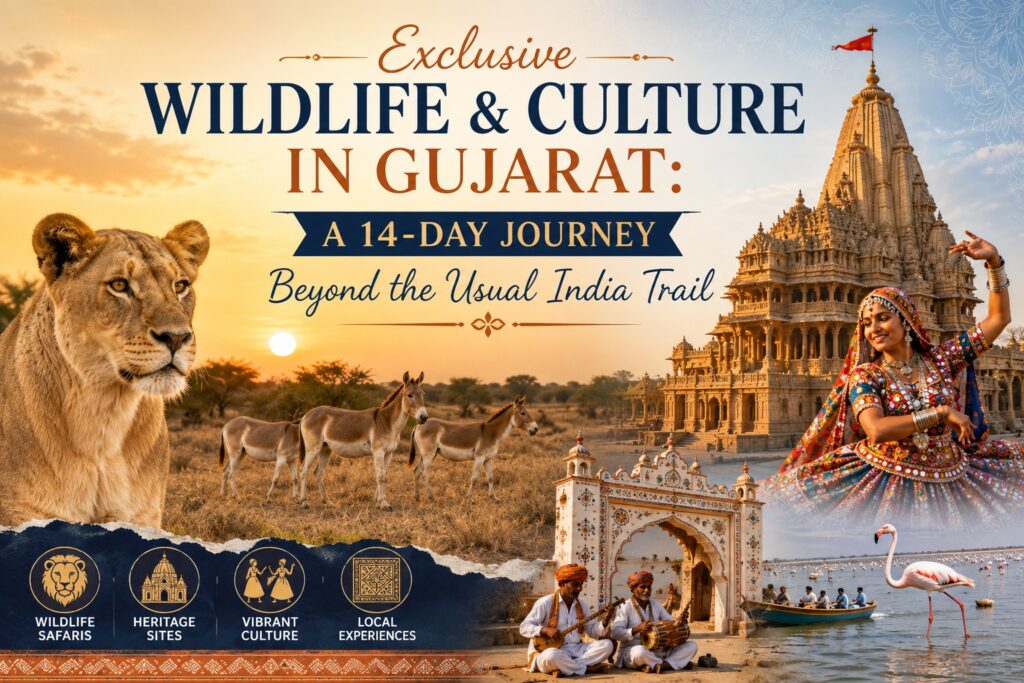
A Gujarat culture and wildlife group tour is a 14-day, 12-night small-group journey (6–14 travelers) through northwestern India, combining Asiatic lion safaris in Gir National Park, blackbuck sightings in Velavadar, the salt deserts of the Little Rann of Kutch, and cultural landmarks such as Rani ki Vav, Modhera Sun Temple, and the old city of Ahmedabad. It runs on fixed departure dates, uses curated safari lodges and heritage hotels, and is designed for travelers who want India’s wildlife and heritage experiences without the crowds of the mainstream circuit.
Introduction: Why Gujarat Deserves a Place on Your India Itinerary
When people plan a trip to India, Gujarat rarely makes the shortlist. Rajasthan gets the palaces, Kerala gets the backwaters, and the golden triangle of Delhi-Agra-Jaipur gets the tourists. Yet Gujarat quietly holds something none of those destinations can offer: it is the only place on Earth where you can watch wild Asiatic lions walk free outside Africa.
This Gujarat culture and wildlife group tour was built specifically for travelers who have grown tired of overcrowded monuments and predictable safari circuits. Over 14 days and 12 nights, the itinerary moves through vast grasslands, dry deciduous forests, and the otherworldly white expanse of the Rann of Kutch, while weaving in some of India’s most significant — and least visited — UNESCO World Heritage Sites.
If you are searching for a Gir lion safari tour Gujarat travelers rarely get to experience in small groups, or a Gujarat heritage and wildlife tour that treats culture with the same seriousness as safari, this guide walks you through exactly what the journey involves, what to expect, and why this region has quietly become one of India’s most rewarding travel destinations.
Trip Snapshot
| Duration | 14 days & 12 nights |
| Travel Dates | 27 February 2027 – 12 March 2027 |
| Group Size | 6 – 14 people |
| Tour Type | Small-group, guided, wildlife and cultural immersion |
| Accommodation | Luxury hotels and carefully selected safari lodges |
| Best Suited For | Wildlife photographers, heritage travelers, small-group explorers |
What Makes This a True Gujarat Culture and Wildlife Group Tour
Most wildlife tours in India focus on a single park. Most heritage tours skip nature entirely. This itinerary was designed differently — as a genuine Gujarat culture and wildlife group tour where safaris and sightseeing carry equal weight, and neither feels like an afterthought.
Gujarat’s geography makes this possible in a way few Indian states can match. Within a two-week loop, the region offers:
- Dense forests sheltering the world’s last wild Asiatic lions
- Open grasslands built for blackbuck and blackbuck predators
- A salt desert so vast it has its own microclimate and mirage effect
- Walled cities with centuries-old stepwells, temples, and textile traditions still practiced today
Few destinations in Asia allow travelers to move between such contrasting ecosystems and cultural sites within a single, unhurried itinerary — and fewer still do it in small groups capped at 14 people, keeping the experience personal rather than logistical.
Gir National Park: The Heart of the Gir Lion Safari Tour Gujarat Experience
No conversation about wildlife in Gujarat begins anywhere but Gir. This forest is the last remaining natural habitat of the Asiatic lion, a subspecies once found across the Middle East and South Asia and now confined almost entirely to this one pocket of India.
A Gir lion safari tour Gujarat itinerary typically includes multiple safari drives spread across early mornings and late afternoons, timed around when lions are most active. Beyond lions, Gir supports:
- Leopards, often more elusive but present in good numbers
- Striped hyenas, rarely photographed elsewhere in India
- Indian wolves in the surrounding scrublands
- Over 300 recorded bird species, making it a strong destination for birdwatching alongside big-cat sightings
What sets a small-group safari apart here is flexibility. With only a handful of travelers per vehicle, guides can wait longer at a sighting, reposition for better light, and adjust routes based on real-time tracking reports from forest rangers — something far harder to coordinate in larger tour groups.
Velavadar Blackbuck National Park: Gujarat’s Grassland Secret
After the forests of Gir, the itinerary shifts to an entirely different landscape at Velavadar Blackbuck National Park — one of the last surviving tropical grassland ecosystems in India.
Velavadar is best known for:
- Large herds of blackbuck, India’s most striking native antelope
- One of the highest densities of wolves in the country
- Wintering harriers, with the park serving as one of the largest harrier roosting sites in Asia
- Wide, open sightlines that make for exceptional wildlife photography
Because Velavadar sees a fraction of the visitors that better-known parks receive, jeep safaris here feel closer to a private nature walk than a tourist circuit — a detail that consistently surprises first-time visitors to Gujarat.
The Little Rann of Kutch: Salt Deserts, Wild Asses, and Flamingos
Few landscapes in India are as visually arresting as the Little Rann of Kutch. This seasonal salt marsh transforms into a blinding white desert for much of the year, interrupted by “bets” — raised islands of grass that support surprising biodiversity.
Highlights of this stretch of the tour include:
- The Indian wild ass, found nowhere else on the planet in the wild
- Large flocks of flamingos, particularly striking against the white salt flats
- Desert foxes, nilgai, and a wide variety of migratory birds
- Surreal, minimalist landscapes that have become a favorite among landscape photographers
The Rann’s stark beauty offers a deliberate contrast to the dense forests of Gir and the grasslands of Velavadar, reinforcing why this itinerary is structured as a complete ecological journey rather than a single-park safari trip.
Cultural Immersion: The Other Half of the Journey
A Gujarat heritage and wildlife tour would be incomplete without dedicated time in Gujarat’s historic cities and UNESCO sites. This itinerary treats culture as a core pillar, not a filler day between safaris.
Ahmedabad’s Old City
Ahmedabad, India’s first UNESCO World Heritage City, anchors much of the cultural portion of the trip. Its old quarter is a maze of centuries-old pols (traditional residential clusters), intricately carved havelis, mosques blending Hindu and Islamic architectural styles, and bustling markets that have operated for generations.
Rani ki Vav
This 11th-century stepwell in Patan is widely regarded as one of the finest examples of stepwell architecture in India. Built as an inverted temple, its seven levels are covered in over a thousand sculpted panels depicting deities, apsaras, and mythological scenes. It remains one of India’s most photographed — yet internationally underrated — UNESCO World Heritage Sites.
Modhera Sun Temple
Dedicated to the sun god Surya, this 11th-century temple is engineered so that sunlight strikes the main shrine directly during the equinoxes. Its stepped tank, ornately carved pillars, and precise astronomical alignment make it one of India’s most remarkable architectural achievements.
Gondal and the Naulakha Palace
In Gondal, the tour visits royal palaces including the Naulakha Palace, offering insight into Gujarat’s princely-state history. Vintage car collections maintained by the former royal family add an unexpected layer to the visit, showcasing a side of Gujarat’s heritage rarely covered on standard India itineraries.
Living Textile Traditions
Gujarat’s textile heritage is not confined to museums. The tour includes hands-on encounters with:
- Patola silk weaving, a double-ikat technique so labor-intensive that a single sari can take months to complete
- Mata-ni-Pachedi textile art, a sacred cloth-painting tradition historically used as portable shrines by nomadic communities
These experiences connect travelers directly with artisans, offering context that a museum display simply cannot replicate.
Why Choose a Small-Group Gujarat 14-Day Group Tour
Group size fundamentally shapes the quality of a wildlife and cultural trip. This Gujarat 14-day group tour is deliberately capped between 6 and 14 travelers, and that decision affects nearly every part of the experience.
Better wildlife sightings. Smaller groups mean fewer vehicles competing for position at a sighting, quieter safaris, and guides who can adapt routes based on individual interest — whether that’s extended time with a lion pride or a slower pace for bird photography.
Deeper cultural access. Artisan visits, temple walks, and palace tours work better in small numbers. Weavers and craftspeople can demonstrate techniques and answer questions directly, rather than performing for a large, rotating crowd.
Comfort without excess. The itinerary balances luxury hotels in cities with carefully selected safari lodges near the parks — accommodations chosen for proximity to wildlife areas and comfort after long safari days, not simply for star ratings.
Personal tour assistance. With a capped group size, on-ground coordination stays close and responsive, which matters most when covering long distances between ecosystems within 14 days.
Sample Flow of the 14-Day Gujarat Culture and Wildlife Group Tour
While the day-by-day itinerary is tailored to each departure, the overall arc of the journey typically follows this progression:
- Arrival and Ahmedabad – Old city exploration, textile and craft introductions
- Patan and Modhera – Rani ki Vav and the Sun Temple
- Gondal – Royal palaces and vintage car heritage
- Gir National Park – Multiple lion and leopard safaris
- Velavadar – Blackbuck and wolf safaris on open grassland
- Little Rann of Kutch – Wild ass, flamingo, and salt desert exploration
- Departure – Return transfers and trip conclusion
This structure allows travelers to move logically between regions, minimizing backtracking while maximizing time in each wildlife zone and heritage site.
Frequently Asked Questions
What is the best time to take a Gujarat culture and wildlife group tour? Late February to March, as covered in this itinerary, falls within Gujarat’s dry season, offering good wildlife visibility in Gir and Velavadar along with comfortable daytime temperatures for cultural sightseeing and safari drives.
Is this tour suitable for wildlife photographers? Yes. Small group sizes, multiple safari drives across Gir, Velavadar, and the Little Rann of Kutch, and flexible vehicle positioning make this itinerary well suited to serious wildlife and landscape photography.
How many wildlife areas does the tour cover? Three primary ecosystems: Gir National Park (forest), Velavadar Blackbuck National Park (grassland), and the Little Rann of Kutch (salt desert), each supporting distinct species and landscapes.
What cultural sites are included in the Gujarat heritage and wildlife tour? Key sites include the old city of Ahmedabad (a UNESCO World Heritage City), Rani ki Vav stepwell, Modhera Sun Temple, and the royal palaces of Gondal, alongside artisan encounters with Patola weaving and Mata-ni-Pachedi textile art.
Is prior wildlife safari experience required? No. The tour is designed for travelers of varying experience levels, with guides handling logistics, park permits, and safari coordination throughout.
How large is the group on this tour? Group size is capped between 6 and 14 travelers, keeping the experience personal while still offering the camaraderie of group travel.
Final Thoughts: An Underrated Region Worth the Detour
Gujarat rewards travelers willing to step outside India’s most-photographed circuit. A Gujarat culture and wildlife group tour built around Gir’s lions, Velavadar’s grasslands, the Little Rann’s salt deserts, and the region’s UNESCO-listed heritage sites offers something genuinely rare: a complete picture of a state that most itineraries overlook entirely.
For travelers seeking a Gir lion safari tour Gujarat experience paired with substantive cultural depth, or a well-paced Gujarat 14-day group tour that doesn’t sacrifice wildlife time for sightseeing (or vice versa), this journey offers a rare balance — 14 days, three distinct ecosystems, centuries of architectural history, and a small group of fellow travelers to share it with.
